

So what is a good business growth strategy for you?
Most business leaders want growth.
But growth is a word that can hide as much as it reveals.
For one business, growth may mean more revenue. For another, better profit. For another, stronger leadership, less dependence on the founder, improved cash flow, better systems, clearer accountability, or a business that can scale without exhausting the people inside it.
This is where many growth conversations go wrong. The ambition is clear enough. The route is not. Leaders often know they want the business to be bigger, stronger, more resilient or more profitable, but they have not always worked through the questions that expose what really needs to change.
That is why I developed SPECIAL, to help you figure out areas where you can grow. The SPECIAL framework is an evolution of the work done on PSEC by Verne Harnish @2014. SPECIAL is a practical business growth framework built around seven areas:
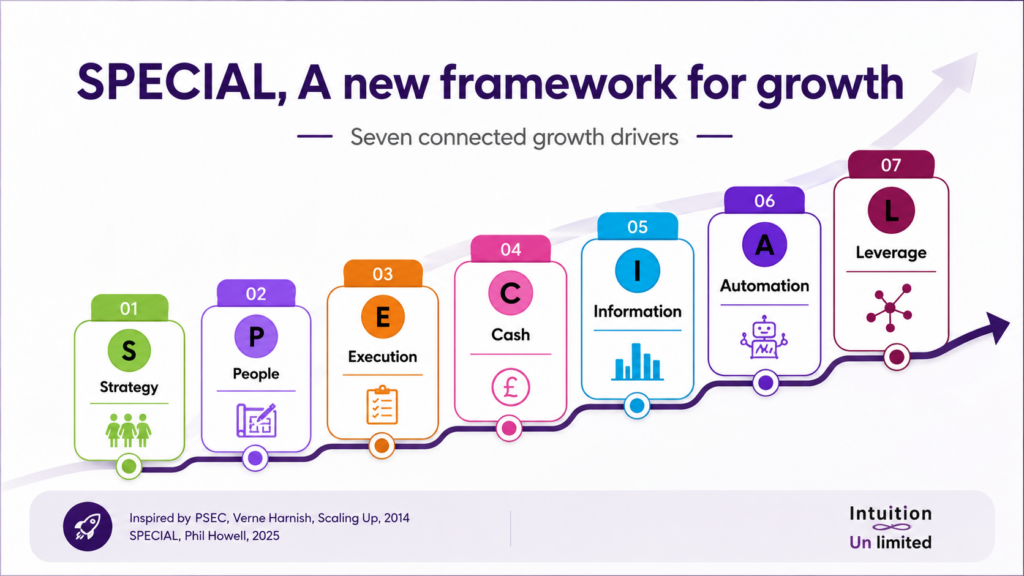
Lets look at each of the areas in turn:
- Strategy
- People
- Execution
- Cash
- Information
- Automation
- Leverage
I introduced the SPECIAL framework for business growth at the National Mentoring Matters Conference in London on 30th October 2025 at the Insurance Hall. It builds on the valuable work of Verne Harnish, who set out the PSEC model, People, Strategy, Execution and Cash, in Scaling Up in 2014.
PSEC remains a useful way to think about business growth. My view, however, is that the way businesses grow has changed significantly since 2014 and the model needed to evolve to refect those changes in the market.
Today, growth is not only shaped by people, strategy, execution and cash. It is also shaped by the quality of information leaders use, the extent to which work can be automated, and the degree of leverage the business can create through technology, partnerships, intellectual property, systems, repeatable offers and better commercial models.
In other words, modern growth needs more than effort. It needs clarity, evidence, discipline, systems and leverage. SPECIAL is designed to help leaders ask better questions of themselves and their business. The value is not in the acronym itself, althougth it is definitely more memorable. The value is in the thinking it creates by going through each area and asking yourself relevant questions.
Because when you work through each part of SPECIAL honestly, the answers usually point towards the actions required to grow the company.
Business growth strategies – where are we going and why?

Growth starts with direction.
Without a clear strategy, a business can become very busy without making enough progress. Teams work hard, but not always on the right things. Sales may increase, but profit does not. New opportunities appear, but they pull the business away from its strengths.
So let us go through the SPECIAL framework together to build some clarity around your vision and strategy.
 Strategy – This is about your choices
- Who do you serve?
- What do you want to become?
- What will you stop doing?
- What trade offs are you willing to make?
These key areas each have questions you should ask yourself to help you define your strategy more fully.

Who do you serve?
The following questions help you clarify your market, customer, value proposition and customer journey.
Customers and Ideal Clients
- Who is your customer now?
- Who do you want as your customer in the future?
- Which customers, sectors, markets or types of work are most valuable to the business today?
- Which customers, sectors, markets or types of work are least valuable, least profitable or no longer a good fit?
- What problem do your best customers really pay you to solve?
- How do you differentiate your value proposition from competitors in a way customers can repeat back to you?
- Which customers would you actively choose more of if you were designing the business from scratch?
Marketing
- What is your current marketing strategy, including channels, message, offers and funnel?
- What is missing, unclear or underperforming in your current marketing strategy?
- Do you understand your customer journey from first awareness to renewal or referral?
- Where are the main drop offs in that customer journey?
- What do your best customers value most about working with you?
- What customer needs are changing, and how well is your business adapting?
The purpose of these questions is to move strategy from a statement into a set of choices. If the answers are vague, the strategy is probably vague too.
What do you want to become?
These questions define the growth ambition, future business model, direction and scale of change.
Vision and Direction
- What is the growth outcome you are aiming for?
- Why did you choose that specific revenue target?
- By when do you plan to achieve it?
- What does the business of tomorrow look and feel like, including clients, services or products, culture, delivery model and reputation?
- Where are you now?
- Where do you want to get to?
- What are the specific gaps in capability, capacity, cash, confidence and systems?
- Is the company direction genuinely clear throughout the business?
- How do you know the direction is clear?
- How is the direction communicated by the leadership team?
- What would success look like if the business grew well, rather than simply grew bigger?
- What kind of business do you not want to become?
Strategy
- What is your strategy for recovery and growth?
- What needs to change in the next 90 days?
- What needs to change over the next 12 to 24 months?
- What must be true in 12 months for you to feel the strategy is working?
What will you stop doing?
These questions help the leader identify what needs to be removed, reduced or deliberately avoided.
- What will you stop doing to make the shift towards your preferred customer real?
- Which products, services, markets or customer types are distracting the business from its best opportunities?
- Which activities create work but do not create enough value?
- Which parts of the business are consuming leadership time without supporting the future strategy?
- What work are you continuing because of habit, history or fear rather than strategic value?
- Where are you saying yes when the strategy requires you to say no?
- Which customers, services or projects would you not take on again if you were making the decision today?
- What meetings, reports, approvals or internal habits no longer help the business move forward?
- What should you simplify before you try to grow further?
What trade offs are you willing to make?
These questions expose the choices, tensions and decisions that leaders often avoid.
- What strategic trade offs are you avoiding, such as focus versus variety, margin versus volume, short term cash versus long term positioning?
- Are you willing to narrow your focus in order to become stronger in a clearer market?
- Are you willing to give up some revenue if it improves margin, capacity or strategic fit?
- Are you willing to invest in capability now, even if it reduces short term profit?
- Are you willing to disappoint some customers, staff or stakeholders in order to protect the future direction of the business?
- What is the cost of not making these choices?
- Which decision would create the most progress if you made it now?
- What are you protecting that may now be holding the business back?
- Where are you trying to keep too many options open?
- If you had to choose between growth, margin, control and freedom, what would you prioritise and why?
 People, who will deliver the growth?

Business growth always places pressure on people.
It tests the leader. It tests the management team. It tests culture, trust, communication, morale and capability. Many businesses do not fail to grow because the opportunity is poor. They fail because the people system is under strain.
The founder is still too involved. Managers are unclear. Staff are tired. Accountability is inconsistent. Decisions are slow. People are working hard, but not always in the right structure.
So what questions should you ask yourself?
- Think through through your typical working day. Where do you add the most value, and where are you being pulled into the wrong work?
- What keeps you awake at night, and what support do you need, practical and emotional, to lead well through it?
- How is morale measured today, directly and indirectly, and what signals tell you there is misalignment or fatigue?
- What people surveys or listening mechanisms do you use, how often, and what actions follow so it is not simply data collection?
- Describe how the leadership team works together. How often do you meet, what do you look at, and how do decisions actually get made?
- What did you learn from the previous leadership approach, and what are you deliberately doing differently now?
- Why did members of staff leave, and what does that tell you about retention risk in the next 3 to 6 months?
- Who are your key stakeholders and supporters right now, and what do they want at this stage, explicitly and implicitly?
- How are you going to integrate into the team, including trust, presence, boundaries and communication style, if you are new or changing your role?
- What leadership skills or qualifications would genuinely make you more effective over the next year, and what will you practise weekly?
The key point is this, you cannot scale a business sustainably if too much knowledge, authority or emotional load sits with too few people.
 Execution, how will we make it happen?

Many businesses do not have a strategy problem. They have an execution problem.
They know broadly what needs to happen, but priorities shift, meetings drift, accountability is unclear, and important actions are not followed through. Execution is where ambition meets habit. It asks whether the business has the operating rhythm to turn plans into results.
Consider these questions to evaluate your Execution:
- Does each member of staff understand their purpose and contribution to achieving the Vision and Strategy?
- What KPI number does each team team and team member own? How is it tracked and reviewed weekly, not monthly?
- Do staff know what their individual contribution should be to build growth beyond “doing the work”, and how is that made visible?
- If there was historical cost cutting, how was this decided, who was involved, what criteria were used, and what unintended consequences are now showing up?
- Where are costs not matching revenue, and what are the operational drivers, such as utilisation, pricing leakage, rework, scope creep or slow delivery?
- If something is handled internally vs outsourced, how many hours a week are spent on it, and what is the opportunity cost?
- What are the 3 biggest bottlenecks in delivery or client acquisition right now, and what would remove each one?
- What is your operating rhythm, including weekly priorities, scorecards and problem solving cadence, and where does it break down?
- What are the must win priorities for the next 30, 60 and 90 days, and what will you pause or stop to create capacity?
- Where is accountability unclear, including decision rights, handovers and ownership of outcomes, and what would clear look like?
- What is one execution habit you will change immediately, such as meeting discipline, follow ups, pipeline review or client feedback?
Execution improves when the business gets clearer about ownership, priorities and review. Good execution is not about working harder. It is about making sure the right work is done, by the right people, at the right pace, with the right follow through.
 Cash, can the business fund the growth?
Growth consumes cash.
This is one of the realities business leaders sometimes underestimate. A growing business may need more people, stock, systems, marketing, management capacity and working capital before the benefit appears in the bank. That is why cash needs to be central to any growth conversation.

Revenue is not enough. Profit is not enough. A business also needs the cash discipline to survive the stretch.
Questions to ask yourself:
- What does cash flow, burn or runway look like on a 13 week view, and what assumptions sit underneath it?
- What are the key cash drivers in your model, including pipeline, conversion, pricing, margin, utilisation and debtor days, and which one moves fastest?
- How long can the business continue in the current state, and what is the real deadline or urgency if nothing changes?
- Which market segments or clients are most productive and profitable, and which are busywork with low return?
- Where is cash leaking, such as discounting, write offs, scope creep, slow invoicing or slow collections, and who owns fixing each leak?
- What pricing or packaging changes could you make to improve margin without harming trust or quality?
- What cost base is truly fixed versus variable, and what would a right sized cost structure look like for your next growth stage?
- What is your plan to improve cash in the next 2 to 6 weeks, including collections, invoicing cadence, deposits and payment terms?
- Are there any external funding or support options worth exploring, including grants, tax reliefs or sector schemes, and who will investigate them properly?
- If you had to protect only three spending lines to enable growth, which would they be and why?
Cash questions often expose whether the business is genuinely ready to grow or simply hoping that growth will solve underlying weaknesses.
Sometimes the better first move is not more sales. It is better pricing, tighter scope control, faster invoicing, clearer collections, stronger margin analysis or less low value work.
 Information, what do we know and what are we guessing?
Leaders make better decisions when they have better information.
Yet many businesses are still run on partial data, late reports, inconsistent definitions and assumptions that have not been tested. Information is not the same as data. A business may have plenty of data, but still lack the insight needed to act.

The question is whether the leadership team can see what is really happening early enough to make good decisions.
Questions to ask yourself:
- What is the relationship between leads and sales today, where do handovers fail, and what is the typical lead time to close?
- How do you track prospect conversion, and how do you understand why potential business is lost, not just that it was lost?
- How are sales distributed by segment, offer, region, channel, salesperson, existing clients and new clients?
- What is the market doing? Are you losing out to competitors, or is the market shrinking? What evidence supports your view?
- Are there new competitors, substitutes or changes in your sector, such as regulation, technology or buyer behaviour, impacting demand?
- Is your data giving you the information you need to analyse the situation, and what are your blind spots right now?
- What factors led to this situation, including the timeline of decisions, leading indicators you ignored and external shocks?
- What are the five numbers you trust most to run the business weekly, and who owns each number?
- How accurate is your forecasting today, and what would improve it, including definitions, data quality, cadence and accountability?
- What customer signals are you listening to, such as complaints, churn reasons, win and loss, NPS and referrals, and what are they telling you?
Information gives leaders the ability to separate fact from feeling.
It also helps them spot patterns before those patterns become problems.
 Automation, where can we remove drag?
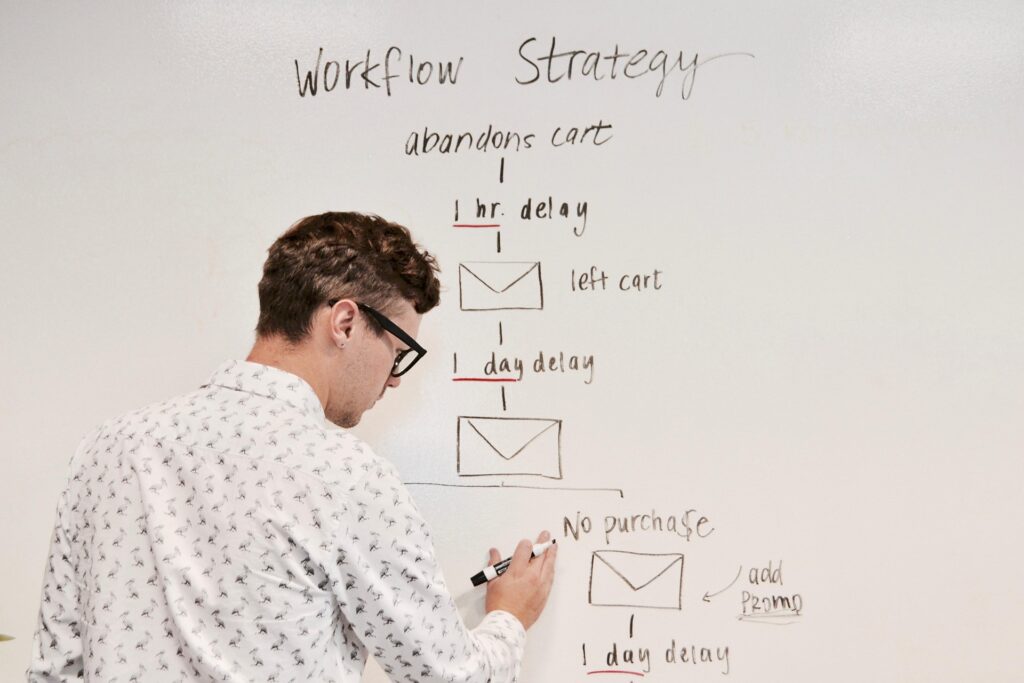
As businesses grow, manual work becomes expensive.
Processes that worked at £500,000 turnover may creak at £2 million. Systems that coped with 10 people may break down at 30. A founder who once remembered everything becomes the bottleneck.
Automation is not about replacing people.
Used well, it releases people from repetitive, low value or error prone work so they can focus on judgement, service, relationships and improvement.
Questions to ask yourself:
- How do your software systems integrate with each other, and where are the manual handoffs creating delays or errors?
- Which repeatable processes are still run through email or spreadsheets that should be systemised, and why have they not been yet?
- How can you routine re-examine processes for process improvement.
- What tracking systems or CRM do you use today, what is adoption like, and what would good usage look like in practice?
- Have you tapped into AI automation yet, and where could it save time quickly, such as content, proposals, research, meeting notes or client communications?
- What would a single source of truth look like for pipeline, delivery and finance, and what is stopping it?
- Which automations would most improve marketing to sales follow up, such as speed to lead, nurture sequences, reminders and reporting?
- Where could automation reduce operational drag, such as time capture, invoicing, onboarding, task routing or knowledge management?
- What are the risks and compliance constraints, and how will you mitigate them while still moving forward?
- Who owns automation prioritisation and change management so tools do not become shelfware?
- As MD or leader, what are you great at, what do you hate doing, and what could you delegate or automate immediately?
Automation should start with business need, not software enthusiasm.
The best question is not “What tool should we buy?”
It is “Where is repeated work slowing us down, costing us money, creating errors or stopping good people from doing better work?”
 Leverage, how do we grow without simply adding more effort?
Leverage is one of the most important growth questions.
Many businesses try to grow by adding more of the same.
- More hours.
- More people.
- More sales activity.
- More pressure.
Sometimes that is needed. But it is not always the best answer.
Leverage asks how the business can create more value from the assets, relationships, knowledge, systems and reputation it already has.

Questions to ask yourself:
- Have you considered looking outside the business for connections or partnerships, and who has your audience but not your offer, and vice versa?
- Who are your key supporters and advocates, including clients, alumni, suppliers, board and community, and how will you activate them intentionally?
- What referral engines could you build through partners, associations, thought leadership or client programmes that compound over time?
- Where can you productise your expertise, such as offers, diagnostics, playbooks or training, so growth is not purely hours for fees?
- What intellectual property or assets could you build that increase valuation and reduce dependence on specific individuals?
- What leverage does technology give you, including platforms, repeatable workflows and self serve resources, that you are not using yet?
- What work should be outsourced or simplified so your best people focus on high value outcomes?
- How could you change commercial models to create leverage, such as retainers, subscriptions, bundles, performance fees or licensing?
- Where is leadership cohesion a leverage point, and what one change in alignment would unlock disproportionate progress?
- If you could free up 10 hours a week, where would you reinvest that time for maximum growth impact?
Leverage is often the difference between a business that grows by strain and a business that grows with greater control.
The real value of SPECIAL
SPECIAL is not intended to be a checklist that leaders rush through. It is designed to provoke thinking outside what you may have already thought of, creating better information on which to make strategic decisions.
Special is a structured way to think. Its value comes from the honesty of the answers and the action that follows. Use the questions above to identify new questions you should get answers to so you can better develop your strategy.
If you work through the seven sections carefully, you will usually find that the issues connect. Weak Strategy creates confused execution. People problems often reveal unclear accountability, weak communication or over reliance on one or two individuals. Inefficient Execution creates stress on scaling, wastes cash and delivers a poorer experience internally and externally. Poor information leads to poor decisions. Cash pressure exposes weak pricing, scope control or debtor management. Poor data and Information leads to sub-optimal or bad decsions. A lack of Automation creates inefficiencies and can fail when ownership and process discipline are missing. Leverage where collaborations help exploit opportunities for new markets, products, technology, IP, processes and access to restricted territories, is often overlooked or not fully exploited.
That is why SPECIAL is useful for business leaders.
It helps you move from general ambition to specific action.
A practical way to use SPECIAL
- Choose one area of SPECIAL where your business feels weakest today.
- Do not try to fix everything at once.
- Start with three questions.
- Answer them honestly.
Then ask:
- What does this tell us?
- What decision have we been avoiding?
- What action is now obvious?
- Who owns it?
- How will we measure progress?
- When will we review it?
Growth rarely comes from one dramatic move. More often, it comes from asking better questions, making clearer decisions and building better habits across the business. SPECIAL gives leaders a way to do that. It helps you see the whole business, not as a set of isolated problems, but as a connected system.
And once you can see the system more clearly, you can begin to grow it more deliberately.
Want to discuss it more?
References
Verne Harnish, Scaling Up, 2014, PSEC model.
Phil Howell, SPECIAL framework, introduced at the National Mentoring Matters Conference, The Insurance Hall, London, 30th October 2025.