

What is a business mentoring case study?
A business mentoring case study is a concise narrative that traces a real client’s journey from an initial problem through to a successful outcome, showcasing the mentor’s approach and the measurable results achieved. Unlike generic marketing copy, it grounds claims in specific evidence, people, data and decisions so that prospects can picture themselves in the same story arc.

Why write a business mentoring case study?
Well-crafted case studies build credibility faster than any brochure: they prove impact, demonstrate thought process and reduce perceived risk for prospective mentees. They also crystallise your methodology, making it easier to explain and refine your service, and they supply ready material for talks, articles and proposals.
Case studies also build the profile of the mentoring profession.
With multiple mentors creating and sharing case studies, it influences the business community, generates interest and engagement, and facilitates business leaders to make enquiries about mentoring, enter change programmes, and then these become the subject of more case studies, so it becomes a self-perpetuating trigger in continuous improvement for businesses and business leaders. The more mentors participate in this initiative, the greater the momentum for change, which in turn impacts a larger number of enterprises, and the economy and mentoring continue to grow.
Are there different types of case studies?
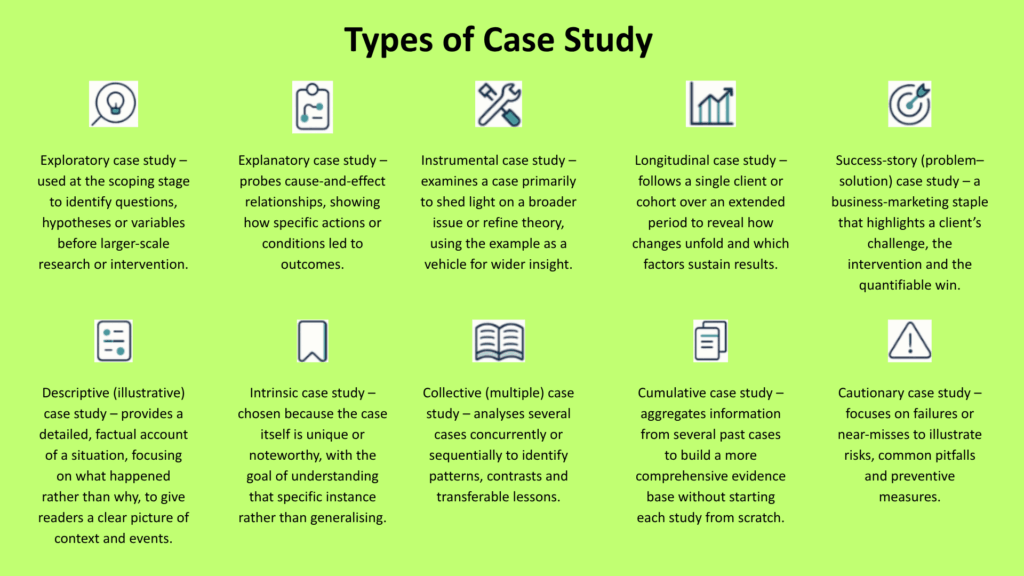
There are several different types of case studies, including:
- Exploratory case study – used at the scoping stage to identify questions, hypotheses or variables before larger-scale research or intervention.
- Descriptive (illustrative) case study – provides a detailed, factual account of a situation, focusing on what happened rather than why, to give readers a clear picture of context and events.
- Explanatory case study – probes cause‑and‑effect relationships, showing how specific actions or conditions led to outcomes.
- Intrinsic case study – chosen because the case itself is unique or noteworthy, with the goal of understanding that specific instance rather than generalising.
- Instrumental case study – examines a case primarily to shed light on a broader issue or refine theory, using the example as a vehicle for wider insight.
- Collective (multiple) case study – analyses several cases concurrently or sequentially to identify patterns, contrasts and transferable lessons.
- Longitudinal case study – follows a single client or cohort over an extended period to reveal how changes unfold and which factors sustain results.
- Cumulative case study – aggregates information from several past cases to build a more comprehensive evidence base without starting each study from scratch.
- Success‑story (problem–solution) case study – a business‑marketing staple that highlights a client’s challenge, the intervention and the quantifiable win.
- Cautionary case study – focuses on failures or near‑misses to illustrate risks, common pitfalls and preventive measures.
How long should a business mentoring case study be?
Case studies can be short, medium or long. So what do these look like?
| Type of case study | How to make best use of this | |
| Short | Single slide with highlights Few paragraphs | This could be a single slide in a proposal powerpoint deck or a few paragraphs in a document. It may be an example or brief in an audio narrative like a podcast or recording. |
| Medium | 1-2 slides in a proposal or presentation – with range of key points. 1/2 page to a full page in documents | Include medium length case studies in proposals, documents or web pages. Consider either in body or use the appendices. With greater space you can go into more depth. The focus always has to be the reader. Who are they and what do they want. |
| Long | Set of slides Multiple pages in a document Full podcasts | Longer case studies are either documents in their own right such as articles on webpages, separate word documents, or a series of slides taking the reader through the journey to the benefits. Consider either separate document or include the case study in the appendices. Audio/video versions might be the whole podcast/video. With greater space you can go into more depth. The focus always has to be the reader. Who are they and what do they want. |
What type of business mentoring case study should I use?
A typical case study in mentoring is the “Success‑story (problem–solution) case study”.
This type of study lends itself to situations where a change programme is implemented in a business, whether it’s for a small or large company, an individual, or a team, as change is often about moving the business and its people from State A to State B, capturing the story of the change, bringing the journey, to life.
Should the business mentoring case study be cited or remain anonymous?
It’s best to use a cited case study, wherever possible, as these tend to attract more credibility and have a greater impact; however, this is not always feasible. So what can you do instead?
Case studies that keep the client’s identity under wraps are perfectly valid and often essential. They work best when narrated with strong storytelling and clear evidence of impact, compensating for the absence of a recognisable brand or spokesperson.
a) When to opt for anonymity
- Privacy constraints – Legal, ethical, or personal considerations may prevent you from naming the client; anonymity ensures compliance with these constraints.
- Sensitive sectors – Fields such as cyber‑security or any engagement involving commercially critical data often demand confidentiality to protect the client.
- Credibility through outcomes – If the narrative is robust and the results are measurable, an unnamed case can still prove competence and build trust.
- Internal learning – Anonymous examples allow you to share success stories and best practices within your organisation without exposing client details.
b) Tips for making anonymous case studies effective
- Lead with the narrative – emphasise the challenge, solution, and results in an engaging, logical flow.
- Be detailed – even without naming the client, provide concrete details about the problem, process, and outcome.
- Present the numbers – utilise complex data and metrics to quantify the value delivered.
- Keep it polished – write concisely, maintain a professional tone, and ensure the piece reflects well on your firm.
c)Potential drawbacks of anonymous case studies
Handled thoughtfully, anonymous case studies let you showcase success while safeguarding confidentiality. Ensure the story is vivid, the evidence compelling, and the value unmistakable; that way, you offset the absence of a named client and still earn the reader’s confidence.
- Lower social proof – A cited brand carries instant credibility that an anonymous case lacks.
- Limited top‑funnel impact – For broad, early-stage marketing, named studies usually resonate more strongly.
What should you include in a business mentoring case study?
| Sections in a Case Study | How to complete a case study |
| a. Client Overview | Provide a brief portrait of the mentee or organisation: industry, size, market position, leadership context and any relevant performance indicators. A client overview sets the audience’s expectations and demonstrates your understanding of the client’s environment. Consider including a statement on how the mentee found the mentor and why they chose them. |
| b. Situation / Challenge | Describe the specific pain‑points or constraints the client faced before mentoring began, e.g. stalled growth, leadership transition, cultural issues or strategic uncertainty. Keep it factual and measurable to establish a clear “before” state. |
| c. Objectives | State the agreed mentoring goals, linking them to tangible business outcomes and personal development aims (for example, increase EBIT by 10 %, build a succession pipeline, or improve board‑level influence). |
| d. Approach / Methodology / Tools | Outline your mentoring framework, including meeting cadence, diagnostic assessments, coaching models, reflection exercises, and any specialist tools such as 360-degree feedback or strategy canvases. Explain how each element supports the objectives. |
| e. Implementation | Summarise how the mentoring unfolded in practice, key milestones, workshops, action plans and the client’s commitment between sessions. An explanation of the steps in the implementation shows the rigour and structure behind the engagement. |
| f. Outcomes | Think of tangible and intangible outcomes: i) tangible outcomes What was the ROI for this engagement? Present the quantifiable outcomes achieved during the mentoring period: revenue uplift, cost savings, team engagement scores, or personal KPIs such as decision-making speed. Where possible, include timeframes and percentages. ii) Intangible Benefits & Impact Move beyond raw numbers to highlight wider value: stronger leadership confidence, improved strategic clarity, enhanced stakeholder relationships and a culture of continuous learning. Link these benefits to long‑term organisational resilience. iii) Lessons Learned Reflect on insights gained by both mentor and mentee, what worked, what could be refined, and how future engagements might be accelerated. Including your lessons learned demonstrates a learning mindset and authenticity, making the business mentoring case study more relatable as you acknowledge that you can make mistakes. |
| g. Conclusion & Future Steps | Close with a concise summary of progress and outline any ongoing or next-phase support, such as quarterly check-ins, advanced workshops or peer‑mentoring circles, signalling a clear path forward. |
| h. Client Testimonial / Endorsement | Conclude with a concise, specific quote from the client that captures the essence of the mentoring experience and its value, ideally referencing measurable results. Authentic, permission‑based testimonials build credibility and trust. |
7. How to go about creating a successful business mentoring case study?
You can write a business mentoring case study at the end, but you increase the likelihood of getting a cited case many fold by setting out with that intention from the beginning. Lets look at what you can do at each stage in the journey with your client.
a) What to do during Discovery, onboarding or in the 1st session to create a successful case study.
- During your discovery/onboarding/1st sessions, consider sharing with the client that, at the end of the mentoring programme, you will ask them to participate as a business mentoring case study.
- It’s flattering. It sows the seed in the client’s mind that there will be a case study. There is no obligation for them to commit then, and it allows them the duration of the mentoring programme to get more and more comfortable with the idea. It also sets an expectation for them to initiate improvements, which can help with their commitment to change, and it encourages you to facilitate further improvements. That is also a good time to mention that you may ask them at the end for a testimonial, a review, a referral, or for ongoing work, etc.
b) What to do at the end of each mentoring session to create a successful business mentoring case study?
In the last section of each session, when you are wrapping up the session, ask,
i) Value questions
- “What did you value from this session?”
- “What did you learn from it?”
- “What was the most valuable insight you gained today?”
- Also consider asking
- “Which part of the discussion resonated most with your current challenges?”
- “How confident do you feel about applying today’s takeaways?”
- “What specific action will you take before our next meeting?”
- “Where did you feel most supported during the session?”
- “On a scale of 1–10, how useful was today’s conversation—and what would move it closer to 10?”
ii) ‘Even better if’…questions
- “What would make our mentoring sessions even better?”.
- “Were any points unclear or in need of deeper exploration next time?”
- “Was there anything you would have liked to spend more time on?”
- “How did the pace and structure of the session work for you?”
- “What feedback do you have on my mentoring style today?”
- “What resources or support would help you implement the agreed actions?”
- “How can I adapt future sessions to align better with your objectives?”
c) What to do after each mentoring session to create a successful business mentoring case study.
TIP: Summarise these back to the mentee in an email after each session.
TIP: Accumulate these in a tracking document that you resend to the mentee periodically, so over time, they can see the value they have gained from the sessions, building each time, and then they won’t forget the benefits they gained during the programme.
TIP: As you go through, start building the case study by filling it in. As you progress, you will become clearer on where the gaps are in the case study and can focus more on those areas.
TIP: Gather hard metrics and qualitative insights through interviews or session notes.
d) What to do at the end of the mentoring programme in the last session to create a successful business mentoring case study.
Remind the client of your desire to write a case study. Check they are onboard. Explain that they have the option of choosing whether it should be cited or anonymous.Let them know that you will compile a draft case study and ask for them to review it and consent to its use.
Review the progress of the mentoring with perhaps an “After Action Review” (AAR). Initially developed by the US Army. Often, it’s an exercise that’s not written down to facilitate learning and avoid blame.
Purpose & Scope – Consider why you are holding the AAR. What activities will it cover?. Focus on facts and what the specific outcomes were,
Event Overview – Create a brief description of the activity that you are reviewing.
What was supposed to happen? What were the objectives, strategies and plans?
What did happen? What went well? Could you list out the successes and strengths that are worth repeating? What are the areas for Improvement? Were there issues experienced, what gaps were identified, and what risks came to light?
Was there a difference? Could you compare what should have happened and what did happen? What caused the results you saw or experienced?
What can we learn from this? What can we apply to future activities to make them more successful?
Recommended Actions – Identify specific actions, assign responsibility, and specify deadlines.
Follow-up & Monitoring – How will you know that progress is being made? What will be tracked and reported?
Appendix – This may include data, charts, supporting information, images, logs, and other relevant materials.
- Update your draft case study that you were compiling throughout the mentoring programme with information from the last session.
- Write it in the positive. Discuss improvements and changes, as well as challenges being overcome.
- Review the draft with the mentee. Request the client’s consent via email and clarify which data can be shared.
- Draft a clear structure, typically including the ten sections we discussed above.
- Then write it in plain, simple, outcome-focused language.
- Go through a series of iterations with the client to validate the accuracy of your statements.
- Get quotations from the client to add authenticity and cited endorsements. For cited case studies, always secure final approval before publishing.
How can I publish and use a business mentoring case study?
You can now leverage it across multiple channels:
- embed it in proposals,
- feature it on your website,
- share excerpts on LinkedIn, and
- use it as the backbone of conference talks or webinars.
- But please make sure you have permission to share anything identifiable to the business concerned.
- Keep a PDF version handy for one-to-one outreach. Finally, revisit the case every 12–18 months to refresh the results and keep it relevant, ensuring it remains a living proof point of your mentoring value.
Get in touch if you have a question about mentoring.
Phil Howell